Sugar Defender review: what’s on the label and what research supports
Quick verdict
- What it is: a 60 mL liquid dietary supplement, 1 mL per serving, sold as a “blood sugar support formula.”
- Evidence for the finished formula: we found no published peer-reviewed clinical trial of it.
- Evidence for the ingredients: mixed to limited, and often from different forms or amounts than this label can confirm.
- Biggest transparency gap: a 200 mg “proprietary blend” of 22 ingredients with no per-ingredient amounts.
- Who should be most careful: anyone on diabetes medicine, blood thinners or thyroid medicine; anyone sensitive to caffeine; pregnant or nursing people; anyone under 18.
What is Sugar Defender?
Sugar Defender is a dietary supplement sold online as drops. The label describes it as a “Blood Sugar Support Formula” in a 60 mL (2 fl oz) bottle, with directions for adults to take 1 mL a day or as directed by a healthcare professional. Dietary supplements in the U.S. may describe how an ingredient supports normal body function, but they may not claim to diagnose, treat, cure or prevent a disease; only drugs can.[1] Treat any marketing that says otherwise as a red flag.
What’s on the label
We worked from the Supplement Facts panel on the product label image, which is the most reliable thing to judge. Labels can change, so compare it with the bottle you receive.
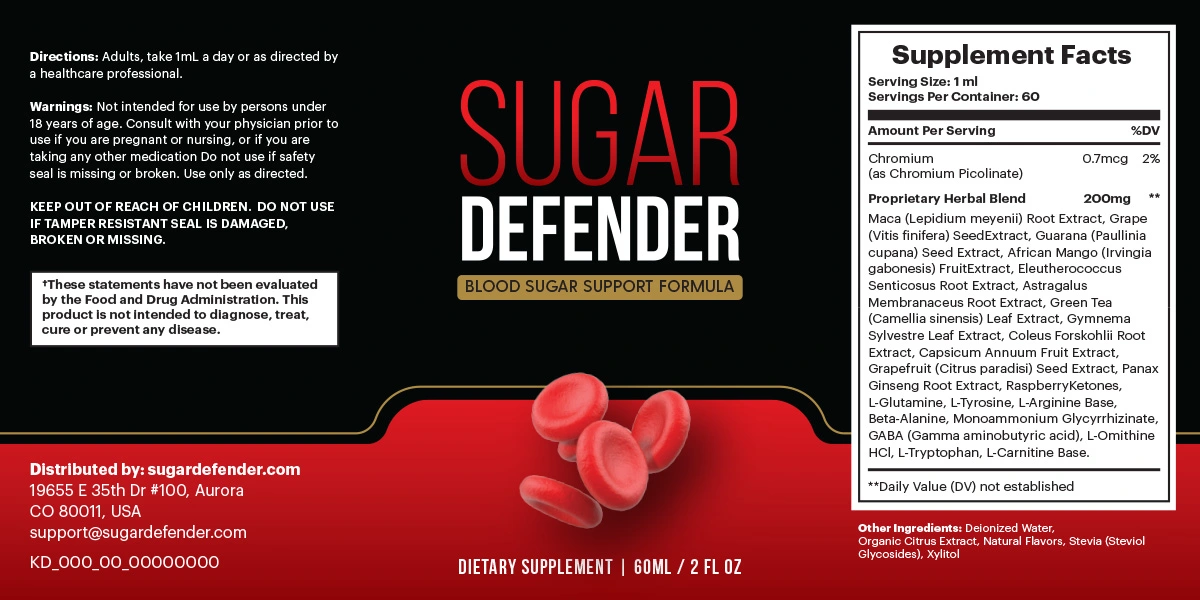
| Item | Amount per serving | % Daily Value |
|---|---|---|
| Chromium (as chromium picolinate) | 0.7 mcg | 2% |
| “Proprietary Herbal Blend” (22 ingredients, listed below) | 200 mg total | Not established |
Blend ingredients as printed: maca root extract, grape seed extract, guarana seed extract, African mango fruit extract, eleuthero (Eleutherococcus senticosus) root extract, astragalus root extract, green tea leaf extract, gymnema sylvestre leaf extract, coleus forskohlii root extract, capsicum fruit extract, grapefruit seed extract, Panax ginseng root extract, raspberry ketones, L-glutamine, L-tyrosine, L-arginine base, beta-alanine, monoammonium glycyrrhizinate, GABA, L-ornithine HCl, L-tryptophan and L-carnitine base. Other ingredients: deionized water, organic citrus extract, natural flavors, stevia (steviol glycosides) and xylitol.
Why the “proprietary blend” matters
A proprietary blend lists a total weight for the group (here 200 mg) but not how much of each ingredient is inside. Ingredients in a blend are generally listed from most to least by weight, but you cannot tell whether the first ingredient is 100 mg or 20 mg. If the 200 mg were split evenly across 22 ingredients, each would be about 9 mg. That is only an illustration, since the real split is not disclosed, but it shows why it is hard to compare the label with studies that used specific, often much larger, amounts.
Chromium: the one ingredient with a stated amount
The label lists 0.7 mcg of chromium as chromium picolinate, which is 2% of the Daily Value. NIH’s adequate intake for adults is 20–35 mcg a day depending on age and sex, so 0.7 mcg is a trace amount, not a meaningful chromium dose.[2] NIH also notes that studies of chromium and blood sugar “have had mixed results,” and that the American Diabetes Association does not recommend chromium supplements for people with diabetes.[2] A systematic review of randomized trials of chromium is listed in our references if you want to read the research yourself.[3]
Do the ingredients have evidence?
Short version: some ingredients have been studied for blood sugar, many have been studied for other things, and several have no research we cite. Our ingredient page goes through all of them. Highlights:
- Panax ginseng: NCCIH calls the research on Asian ginseng for blood sugar control in people with diabetes “overall inconclusive,” and notes insomnia as the most common side effect.[4]
- Gymnema sylvestre: a systematic review of gymnema for diabetes exists, but it concerns the extracts and amounts used in those studies, not this blend.[5]
- Coleus forskohlii: in a 12-week randomized trial in mildly overweight women, the authors reported that it “does not appear to promote weight loss but may help mitigate weight gain,” a trend rather than a clear effect.[6]
- African mango: the human trial we cite used seeds, while this label lists a fruit extract. That is not the same thing.[7]
- Maca and eleuthero: the research we cite is about energy, fatigue or reproductive health, not blood sugar.[8][9]
Pros and cons
Reasonable points
- The Supplement Facts panel is shown in full, with named ingredients and a stated serving.
- The label tells people who are pregnant, nursing, under 18 or on medication to consult a professional.
- Low-dose, once-a-day format is easy to track.
- The seller states a money-back guarantee (verify the terms before ordering).
Concerns
- 22 ingredients in a 200 mg proprietary blend, so doses are unknowable.
- Trace chromium (0.7 mcg), far below the 20–35 mcg adequate intake.
- No peer-reviewed trial of the finished formula found.
- Stimulant-type ingredients (guarana, green tea) with no caffeine amount listed.[10]
- Possible interactions with diabetes medicine, which the ingredient sources warn about.[2][4]
Who should avoid it or talk to a professional first
- Anyone taking insulin or other diabetes medicine. NIH says chromium with insulin or antidiabetes medicine might cause low blood sugar, and NCCIH says ginseng might lower blood sugar.[2][4]
- Anyone on blood thinners or with an autoimmune condition. NCCIH notes ginseng may interfere with blood clotting and may worsen autoimmune disorders.[4]
- Anyone who is pregnant, nursing or under 18, as the label itself advises.
- Anyone who is sensitive to caffeine or has trouble sleeping.
Read our side effects and interactions guide before deciding.
Price, guarantee and how buying works
Pricing varies by pack size and promotion, so we do not list prices that could go out of date. A bottle contains 60 servings of 1 mL, so at the label dose one bottle lasts about 60 days; divide the price by the number of days to compare with other products. The seller states a 60-day money-back guarantee. We do not process orders or refunds. Before ordering, read the refund terms on the checkout page, keep your order confirmation, and ask the seller or ClickBank support if you need help with an order.
The product’s seller page is below. It is an affiliate link.
View Sugar Defender on the seller’s siteAffiliate link — we may earn a commission. Why that matters
Our verdict
We cannot say Sugar Defender will help your blood sugar, and the evidence we reviewed does not show that it does. It is a real labeled supplement with an undisclosed ingredient split and several unanswered questions. If you do decide to try it, do it as a low-stakes experiment with your clinician’s knowledge, keep monitoring as you normally would, and never change prescribed treatment on your own. For things with stronger evidence, see our guide to habits that have evidence.